

Unveiling Actual Users’ Remarkable Brain Age Improvement using Thinkie Technology
TL;DR: This article discusses brain age improvements observed in Thinkie users, highlighting reductions of up to 21 years over three years of training.
The latest research by NeU Corporation, sister corporation to Thinkie, explores fascinating new data regarding the Thinkie System and its impact on brain age improvement among real users. The concept of brain age is evaluated through cognitive tests designed by NeU to measure cognitive speed, working memory, and executive function. This particular study by NeU concentrated on cognitive speed to assess the impact of consistent use of the Thinkie brain training system in lowering brain age.
Thinkie users in this experiment experienced notable decreases in brain age with regular engagement. We encourage you to examine these results closely and consider their implications for enhancing long-term brain health and cognitive performance through the Thinkie system.
1: Brain Training Duration and Brain Age Reduction
NeU analyzed data of 178 individuals aged 40 to 90+ who have engaged with Thinkie brain games for three months or longer and constantly checked their brain age. The change in brain age from each patients’ initial baseline was calculated, with the average change for each month of continuous play depicted in the graph below.
Participants noted reductions in brain age relatively quickly. On average, three months of consistent Thinkie training resulted in a reduction of brain age by 3.7 years. With ongoing practice, these cognitive improvements further accumulate, potentially leading to significant reduction in brain age – in some cases as much as 21 years – after three years of use.
Specifically, the average brain age reduction observed is:
· 3.7 years reduction after 3 months’ use
· 6.8 years reduction after 6 months’ use
· 10.6 years reduction after 1 year’s use
· 12.9 years reduction after 18 months’ use
· 14 years reduction after 2 years’ use
· 21 years reduction after 3 years’ use

2: Brain Age Reduction by Age Group
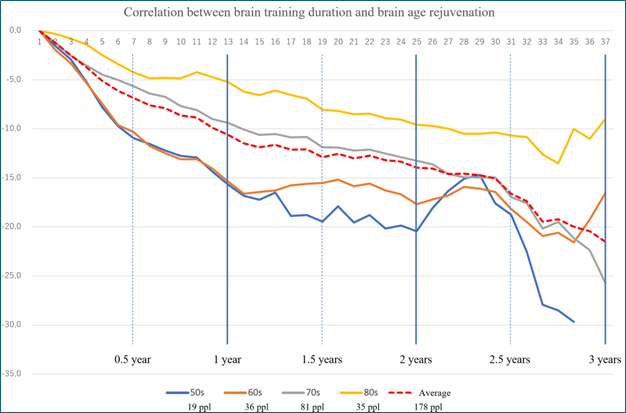
The graph below illustrates the variation in brain age reduction across different age groups.
Comparable enhancements in brain age were observed in older age groups. Participants in their 50s and 60s showed the most pronounced range of brain age reduction over various training durations. For those in their 70s and 80s, while the range of reduction narrowed, it nonetheless remained consistent.
3: Trends in Brain Age Improvement by Training Frequency
NeU also analyzed how the frequency of brain training activities impacts brain age over both the short and long term. Participants were divided into four groups based on training frequency: less than two days per week, two or three days per week, four or five days per week,and six or more days per week.
The findings suggest a correlation between increased training frequency and greater improvement in brain age over a span of 24 months or more. Those engaging once or twice a week saw an average reduction of 10.3 years in brain age after 24 months. Notably, participants exercising their brains almost daily (six or more days) observed the most pronounced improvement, with an average brain age reduction of 16.2 years over the same period.

Summary: Brain Exercises for Cognitive Enhancement
Continuous training led to brain age improvement across all age groups. Dr. Kawashima, the creator of brain age and the Thinkie Brain Training system, and CTO of NeU corporation, advises a minimum of two training sessions per week—preferably four or more—lasting more than 5-10 minutes each for optimal benefits. Nonetheless, even minimal engagement can yield a significant decrease in brain age.
FAQ
- Q: How does Thinkie improve brain age?
- A: Thinkie uses fNIRS-based brain training games designed by NeU Corporation to target key cognitive functions such as cognitive speed, working memory, and executive function, which together determine your measured “brain age.” In a NeU study of 178 adults aged 40–90+, consistent use of the Thinkie system led to progressive reductions in brain age, with average improvements of 3.7 years after 3 months, 6.8 years after 6 months, 10.6 years after 1 year, and up to 21 years after 3 years of continued training. Because the system gives real-time feedback on your brain activity and adapts difficulty, it encourages the right level of challenge so cognitive performance improves over time and those gains show up as a younger brain age score
- Q: How often should I train with Thinkie?
- A: More frequent training is linked with greater brain age improvement, with users who trained 6 or more days per week seeing the largest reductions in brain age over 24 months (about 16.2 years younger on average, versus 10.3 years for those training only once or twice a week). Dr. Kawashima, creator of the Brain Age concept and the Thinkie training system, recommends at least two sessions per week and ideally four or more, with each session lasting more than 5–10 minutes to achieve optimal benefits. Short, regular sessions several times per week are considered the most effective pattern
- Q: How long does it take to see results?
- A: Reductions in brain age appear relatively quickly, with an average 3.7-year decrease after just three months of consistent training. As users continue, their improvements build over time, reaching an average 6.8-year reduction after 6 months, 10.6 years after 1 year, 12.9 years after 18 months, 14 years after 2 years, and as much as 21 years after 3 years of ongoing use. These gains were seen across age groups from the 40s through the 80s, indicating that meaningful change is possible even for older adults who stay engaged with the training program
- Q: Is Thinkie suitable for beginners?
- A: Thinkie is meant for everyday users, not just experts or patients in clinical settings. The System is designed for broad applicability, including healthy adults seeking cognitive enhancement and people beginning to notice subtle cognitive changes, and that its exercises adapt to users’ performance to maintain an appropriate level of challenge. Because training sessions are short (10–15 minutes) and the platform provides clear feedback on brain age and progress, the program is positioned as approachable even for those new to brain training technologies
- Q: What if I miss training sessions?
- A: Even users who train less frequently, such as once or twice per week, still see meaningful improvements, averaging about a 10.3-year reduction in brain age after 24 months, which suggests that imperfect adherence can still be beneficial over time. However, users who trained almost daily (six or more days per week) achieved greater gains, with around a 16.2-year reduction in brain age over the same period, so the implication is that you should return to regular sessions as soon as you can rather than giving up if you miss some days. Continuous, long-term engagement of at least a couple of times per week, and preferably more is what drives the best results, but even “minimal engagement” can still move brain age in a positive direction